
Finance Minister Nirmala Sitharaman announced that India's real GDP grew by 7.8 per cent in the April-June quarter, surpassing the RBI's forecast. She attributed this strong performance to government reforms and agile economic management, reaffirming the government's commitment to expanding economic opportunities.

Which parts of urban India have the highest proportion of households owning gold jewellery or bullion?

India's industrial production expanded at a slower pace of 4.9 per cent in April, primarily due to tepid growth in the energy sector amidst the West Asia crisis. This data marks the first release under the newly revised base year of 2022-23 for the Index of Industrial Production (IIP).

The Ministry of Statistics and Programme Implementation (MoSPI) has upgraded its official data portal to be directly readable by AI models, aiming to prevent reliance on non-credible sources. This initiative includes standardising 288 priority datasets and addressing semantic interoperability challenges to improve public service delivery.

India's economy recorded a robust 7.8 per cent growth in the April-June quarter of fiscal year 2026-27, surpassing both market expectations and the Reserve Bank of India's forecast. This strong performance positions India as the world's fastest-growing major economy, demonstrating resilience despite global economic uncertainties and geopolitical tensions, including the conflict in Iran. The Ministry of Statistics and Programme Implementation highlighted the sustained growth momentum amidst global headwinds.

India's urban unemployment rate for individuals aged 15 and above marginally increased to 6.7 per cent in April-June, while rural unemployment rose to 4.8 per cent, according to the latest Periodic Labour Force Survey (PLFS). This rise in unemployment coincides with a notable decline in the overall labour force participation rate (LFPR) to a five-quarter low of 54.6 per cent.

The Indian government has approved the introduction of one billion polymer banknotes in Rs 10 and Rs 20 denominations for field trials, aiming to enhance durability. This move comes as the Finance Minister also addressed Parliament on declining retail inflation, GST reforms, and other fiscal measures taken to support the economy and household consumption.

'They are claiming that they are very good in governance. All governments do propaganda. This is the propaganda of the government that they are doing very well, in spite of all the troubles.'
'They are claiming that they are very good in governance. All governments do propaganda. This is the propaganda of the government that they are doing very well, in spite of all the troubles.'

Retail inflation stood at 2.75 per cent in January under the new series of All India Consumer Price Index (CPI), with 2024 as the base year, released on Thursday.

The Indian economy is likely to grow at 7.4 per cent in 2025-26, up from 6.5 per cent in the previous fiscal, mainly on account of better performance of manufacturing and services sectors, as per the government data released on Wednesday.

However, the handle, which has over 40,000 followers, was restored later in the afternoon.

India's gross savings rate is projected to be nearly 47 basis points higher in FY25 than previously estimated, following the Securities and Exchange Board of India's (Sebi) revision of the methodology for calculating household savings routed through the securities market.
India's unemployment rate for individuals aged 15 and older increased to 5.1 per cent in March 2026, up from 4.9 per cent in February, primarily due to a rise in joblessness in urban areas, according to government data.

The IMF on Monday raised India's growth projection to 7.3 per cent for fiscal 2025-26, up 0.7 percentage point from its October forecast, on the back of better-than-expected performance of the economy. The Washington-headquartered multilateral lending agency has also revised India's Gross Domestic Product (GDP) growth forecast to 6.4 per cent for fiscal year 2026-27 beginning April 1, 2026, from its earlier estimate of 6.2 per cent.

India's main inflation measure, the Consumer Price Index (CPI), is set for another major update, even though it has been in its current form for only about 15 years.

India's unemployment rate for individuals aged 15 years and above reached a six-month peak of 5.2 per cent in April 2026, according to the latest Periodic Labour Force Survey (PLFS) data.

The Athletics Federation of India (AFI) pledges to collaborate with NADA and the Sports Ministry to address doping concerns after the Athletics Integrity Unit (AIU) categorised India as a high-risk country for doping violations.

India's economy experienced a growth of 7.8 per cent during the October-December quarter of 2025-26, according to the new series of national accounts with 2022-23 as the base year.

A government ministry has proposed decriminalising offences under the Collection of Statistics Act 2008 as part of the government's efforts to rationalise legislations to promote the ease of doing business. The Ministry of Statistics and Programme Implementation (MoSPI) has invited public comments on its draft proposal by October 30. The proposal to amend sections of the act will decriminalise offences like obstructing or deceiving statistics officers by doing away with the provision of simple imprisonment up to six months.

With the dissolution of former chief statistician Pronab Sen-led Standing Committee on Statistics (SCoS) by the Ministry of Statistics and Programme Implementation (MoSPI), the National Statistical Commission (NSC) has regained prominence as the primary statistical body to address issues regarding results, methodology and questionnaire, among others. A MoSPI official in an email informed the 16-member SCoS about the decision to dissolve it, citing that its work was "overlapping" with that of the Steering Committee for National Sample Surveys (NSS), which was set up in June this year.

India's new national accounts will leverage new data sources and surveys to enhance the measurement of the country's informal economy, and introduce double deflation methods across sectors, replacing the current system that relies on a single deflation mechanism in Gross Domestic Product (GDP) calculations.

Unemployment rate for persons aged 15 years and above rose marginally to 4.8 per cent in December 2025 compared to 4.7 per cent in the preceding month. The unemployment rate (UR) or joblessness, among persons of age 15 years and above, remained largely stable in December 2025, according to the Periodic Labour Force Survey (PLFS) released by the Ministry of Statistics and Programme Implementation (MoSPI) on Thursday.

The Gross Value of Output of bananas, adjusted for inflation, surpassed that of mangoes for the second consecutive year in 2023-24.
The rate of unemployment for those aged 15 and above remained steady at 5.2 per cent in October, according to a government survey released on Monday.

The government aims to cover around 60 million people in the age category, irrespective of income, with an assured 5 lakh annually to be shared within the family.
Congress President Sonia Gandhi has pulled up the central government for slow implementation of the UPA's 20-point programme, sources in the government say.

The Ministry of Statistics and Programme Implementation (MoSPI) on Friday said it has advanced the release of macroeconomic data Gross Domestic Product (GDP) estimates by about 90 mins to 4 pm. As per the current practice, the press releases of GDP are scheduled at 5.30 pm on the specified release dates, a MoSPI statement said.
The unemployment rate for those aged 15 and above increased marginally to 5.2 per cent in September, according to a government survey released on Wednesday. The unemployment rate (UR) was 5.1 per cent in August, 5.2 per cent in July and 5.6 per cent in May and June, as per the Periodic Labour Force Survey (PLFS) released by the Ministry of Statistics and Programme Implementation (MoSPI).

The rate of unemployment in the country declined to 5.2 per cent in July from 5.6 per cent in June, a government survey said on Monday. The unemployment rate (UR) in May was also 5.6 per cent, said the Periodic Labour Force Survey (PLFS) released by the Ministry of Statistics and Programme Implementation (MoSPI).

Finance Minister Nirmala Sitharaman on Thursday asked India Inc to take advantage of the policies and reforms undertaken by the government and no longer hesitate to invest more and expand capacities. Sitharaman also asked the industry to partner with the government for skilling the youth and also to engage with the government throughout the year, and not just before the Budget.
The rate of unemployment in the country, measured in monthly term, rose to 5.6 per cent in May from 5.1 per cent in April this year mainly due to seasonal variation, showed the government data released on Monday.

As many as 458 infrastructure projects, each entailing an investment of Rs 150 crore or above, were hit by a cost overrun of more than Rs 5.71 lakh crore in May this year, according to an official report. According to the Ministry of Statistics and Programme Implementation (MoSPI), which monitors infrastructure projects worth Rs 150 crore and above, out of 1,817 projects, 458 reported cost overruns and 831 projects were delayed.

Updated new base years for national accounts and other macro-indicators are expected to come into effect from January-February 2026, coinciding with the first and second advance estimates of national income for FY26, senior official sources aware of the development told Business Standard. "The statistics ministry set up the Advisory Committee on National Accounts Statistics (ACNAS) earlier this week. "It will advise on the base year for GDP (gross domestic product) and its alignment with other macro-indicators.

C P Chandrasekhar, who has served on key statistical panels in the past both as a chairman and member, said he was present in the campus when the ruckus broke out on Sunday and found the incident "disturbing" and "unprecedented", and that it further undermined the faith in the system. Somesh Jha reports.
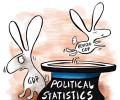
There has been criticism of the official statistics ever since MoSPI came out with new methodology to estimate the GDP on the base year of 2011-12 compared to earlier 2004-05.

India's industrial production (IIP) growth slowed to 3.5 per cent year-on-year in October 2024, mainly due to poor performance of mining, power and manufacturing, as per official data released on Thursday. The IIP recorded a growth of 11.9 per cent in October 2023, according to a statement by the Ministry of Statistics & Programme Implementation.

'Peninsular Indians could ask 'Why should we contribute half of India's tax revenues if we account for only a quarter of the seats in the Lok Sabha?'.' 'The rest of the country seems likely to counter that 'democracy means one vote per person irrespective of where that person resides in India'.' 'With no easy answers to this thorny debate, the south's economic ascendancy could end up creating a Hobson's choice.' A revealing excerpt from Nandita Rajhansa and Saurabh Mukherjea's book, Behold the Leviathan: The Unusual Rise of Modern India.

Net household savings declined sharply by Rs 9 lakh crore to Rs 14.16 lakh crore in three years to 2022-23, according to the latest National Account Statistics 2024 of the Ministry of Statistics and Programme Implementation. The net household savings peaked at Rs 23.29 lakh crore in 2020-21.
